Document management challenges hit small auto dealerships hardest in places that never appear on a P&L—lost time hunting for a repair order, duplicate versions of a sales contract, or a missing inspection report that stalls a warranty claim. Research shows automotive service teams spend an average of 45 minutes daily searching for documents across scattered systems. Adding more cloud storage or another admin rarely fixes the root issue.
The real problem is scattered records and inconsistent processes that compound as volume increases. A modern document management system like Docupile creates structure instead of adding another layer of chaos.
Common Document Management Challenges Across Automotive Businesses
Documents Scattered Across Multiple Storage Systems
Customer files, vehicle histories, repair orders, invoices, and warranty paperwork sit fragmented across paper folders, email inboxes, shared drives, and individual desktops. Industry data reveals that 68% of auto dealerships maintain at least four separate storage locations for business-critical documents. Staff waste significant time switching between systems when a customer calls about service history or a lender needs supporting documents for financing.
- The hidden cost runs deeper: each context switch costs approximately 15 minutes in lost productivity and increases error risk. A dealership processing 30 customer interactions daily faces 7.5 hours of cumulative search time—time that could be spent on sales, service, or customer retention.
Inconsistent File Naming and Folder Structures
Service, parts, sales, and finance teams each develop their own naming conventions. One folder might read “2023-Ford-F150-JohnD,” while another uses dates or initials only. This fragmentation creates duplicates, overwritten files, and confusion when anyone outside that team needs the record. Studies show that 34% of document-related errors in automotive operations stem directly from naming inconsistency and version confusion.
When your finance team cannot quickly verify which sales contract version is current, disputes with lenders, insurers, and customers follow. That ambiguity becomes expensive.
Slow Document Retrieval and Missing or Incomplete Records
During customer calls, warranty submissions, or audit requests, teams often cannot locate complete files quickly. Missing pages or outdated versions delay repairs, payments, and compliance filings. The average automotive business loses 5–8 hours weekly to incomplete record searches alone—time that compounds into thousands of dollars annually in lost labor and missed deadlines.
The Operational Impact: Why Poor Document Organization Matters
Increased Manual Effort and Wasted Time
Employees spend hours sorting, renaming, and refiling documents instead of focusing on vehicle sales, service work, or customer follow-up. According to industry benchmarks, dealerships without centralized document systems allocate 12–15% of administrative time to manual filing—labor that directly reduces profitability.
The temptation is to hire another administrator. But hiring masks the real problem: a broken process cannot be fixed by adding more people to manage it. Docupile customers typically recover 5–8 hours per week of administrative capacity without adding headcount.
Limited Visibility and Missed Critical Deadlines
Without clear visibility into document status, contract renewals, warranty expirations, and compliance deadlines slip through the cracks. Dealerships report an average of 3–4 missed vendor contract renewals annually, each causing service disruptions or inflated renewal penalties. The revenue lost from these oversights frequently exceeds the original cost of disorganization.
| Hidden Cost Category | Frequency | Annual Impact per Dealership |
|---|---|---|
| Missed contract renewals | 3–4 per year | $2,500–$8,000 |
| Warranty claim resubmissions | 15–20 per month | $5,000–$12,000 |
| Compliance audit findings | 1–2 per year | $1,000–$10,000+ |
| Administrative labor waste | Daily | $18,000–$28,000 |
| Total annual drag | – | $26,500–$58,000+ |
Compliance and Security Risks From Incomplete Records
Audits and regulatory requests expose gaps in vehicle histories or employee files. Weak tracking makes it difficult to demonstrate which version was current or who accessed a record. Federal and state regulatory reviews increasingly penalize dealerships for incomplete documentation, with fines ranging from $500 to $5,000 per violation.
One missed inspection report during a state audit can trigger a $2,000+ fine—a cost that would have been prevented by organized, searchable records.
Why Traditional Methods Fail to Scale
Paper filing cabinets, email folders, and shared drives worked when document volume was low. As dealerships grow, these methods create compounding errors rather than sustainable control. Modern automotive businesses process 50–100 documents per transaction; traditional manual systems cannot maintain accuracy or speed at that volume.
The assumption that “we’ve always done it this way” breaks down once daily transactions multiply across departments. Growth exposes the fragility of manual processes—not because staff work less hard, but because human effort alone cannot scale without structure.
A Better Document Management Approach for Automotive Operations
Effective organization starts with one searchable location that replaces fragmented storage. Consistent classification and metadata remove manual inconsistencies. Clear visibility and access rules support both daily operations and compliance needs without adding extra steps for staff. This centralized approach typically reduces document retrieval time by 80% and cuts filing-related errors by 75%.
Docupile: The Smart Solution for Automotive Document Management
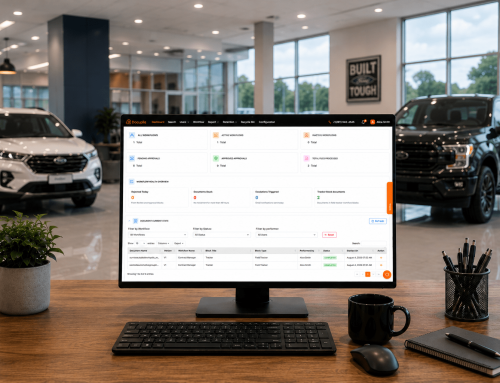
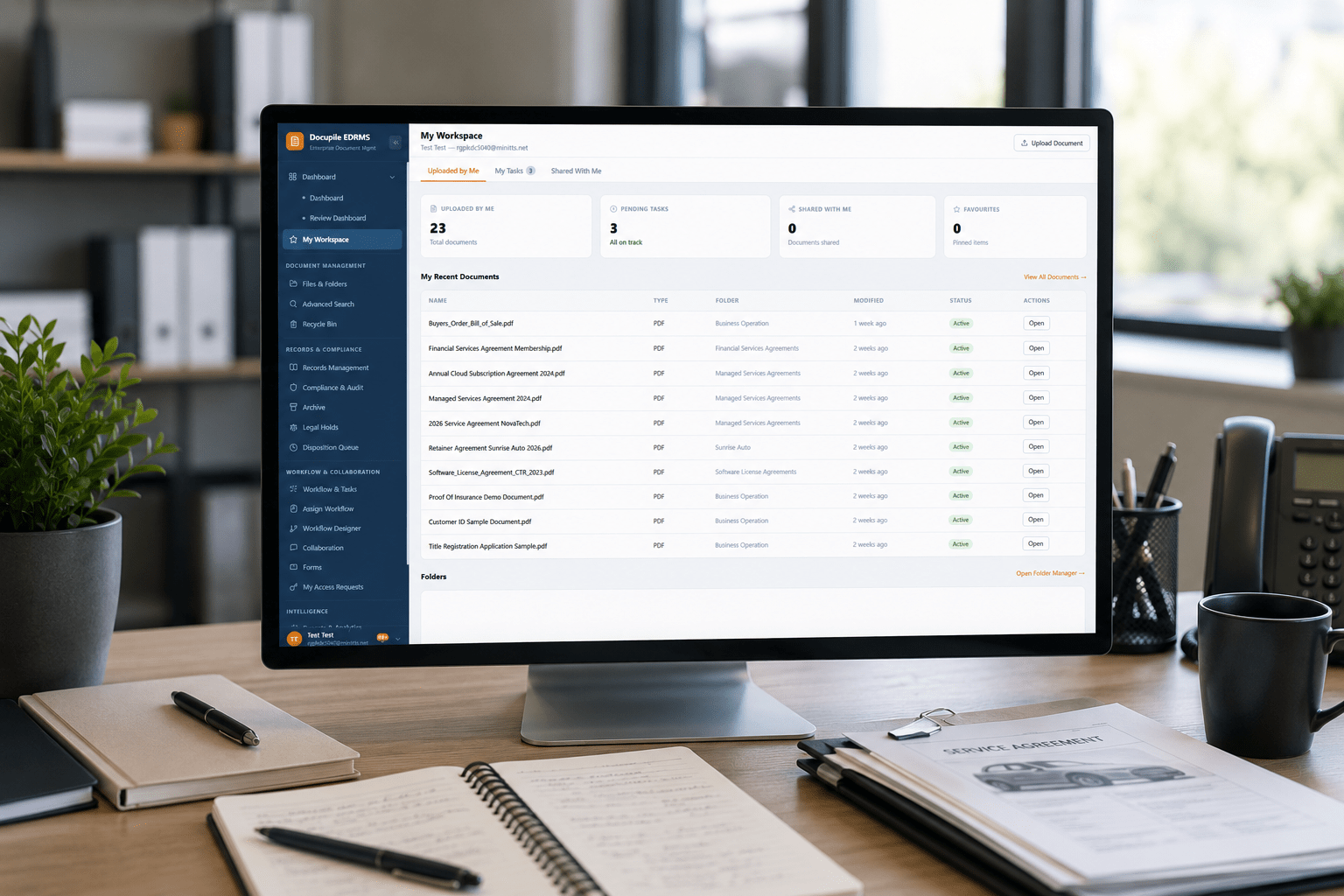
Docupile brings all records into a single, secure repository that replaces scattered systems. Intelligent automation handles naming and classification so teams no longer create conflicting versions.
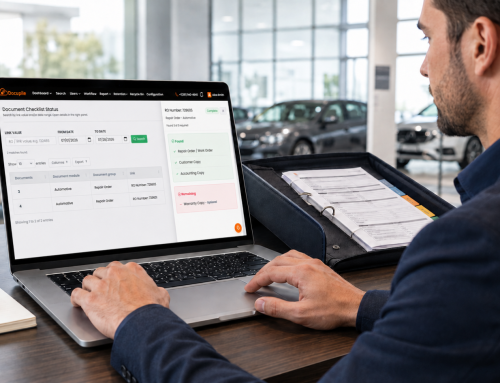
- Deal Jacket management keeps customer and vehicle records organized in one place, making missing paperwork easy to identify during sales or service.
- Vendor Contract management centralizes agreements, tracks renewal dates, and prevents missed deadlines that disrupt parts supply.
- Smart Search delivers instant access to any record—reducing the 45-minute daily search burden to minutes.
- AI Auto-naming applies consistent standards across repair orders, invoices, and customer files without manual intervention.
- Built-in workflow tools, version history, and permission settings keep sensitive information protected while giving the right people quick access.
- Retention rules and audit capabilities support compliance without extra manual tracking.
Benefits of Docupile for the Automotive Industry
Faster Warranty Claim Processing
Complete repair orders and supporting documents surface immediately, cutting claim resubmissions and payment delays by an average of 3–5 days per claim.
Improved Compliance During Audits
Version history and activity records make it straightforward to demonstrate record completeness for inspections and regulatory reviews, reducing audit risk exposure.
Reduced Administrative Burden on Service Teams
Staff spend less time filing and searching, freeing 5+ hours weekly for customer-facing work that directly drives revenue.
Stronger Control Over Vendor and Parts Contracts
Centralized access and deadline tracking prevent missed renewals that could interrupt parts supply or service agreements.
Consistent Records Across Sales and Finance
Automated organization eliminates duplicate or conflicting versions of sales contracts and financing documents, reducing dispute risk.
Secure Handling of Employee and HR Files
Permission settings protect sensitive personnel records while still allowing quick retrieval when needed.
How Docupile Works for Automotive Businesses
Step 1: Document Upload and Capture
Emails, attachments, scanned files, and digital documents enter the system through simple upload or the Outlook Add-In.
Step 2: Automatic Organization and Classification
The platform applies consistent naming, creates logical folders, and indexes key details without manual intervention.
Step 3: Search, Access, and Workflow
Teams retrieve records instantly while permission settings ensure the right people see the right documents.
Step 4: Ongoing Control and Audit Readiness
Version history, activity logs, and retention rules maintain order as document volumes grow.
Move From Chaos to Control
Document disorganization creates real operational drag that traditional methods cannot fix. Docupile helps automotive businesses move from scattered files to organized, searchable, and controlled records in weeks, not months.
Book a demo with Docupile today to see how the platform transforms your document management and helps your team focus on what matters most.