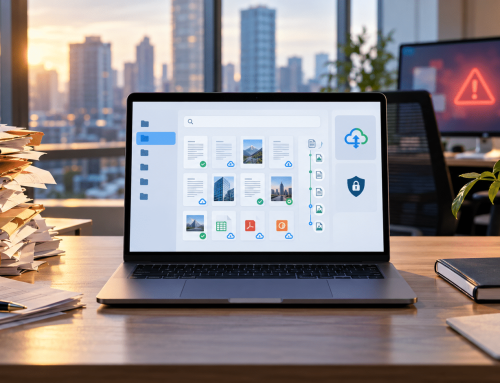

Moving business documents to the cloud solves an obvious problem: files are no longer trapped in filing cabinets, local drives, or one employee’s computer.
But it creates another question:
Who can still access those files?
A signed contract may remain available to someone who changed departments. A vendor may retain access after a project ends. An application connected years ago may still have permissions nobody remembers approving.
That is where cloud document management security becomes important. After an incident, clients, auditors, insurers, or internal leadership may want to know who could access affected records and what happened to them. “We’re not sure” is a difficult answer to give.
Cloud document security therefore goes beyond storage. It also depends on identities, permissions, integrations, external sharing, retention, and visibility into document activity.
The September Dropbox/Lenovo incident illustrates the point. According to reporting cited in Docupile’s published analysis, around 5,000 Dropbox accounts were compromised through a legacy Lenovo ID integration, and the reported access path did not require attackers to know affected users’ Dropbox passwords.
Our earlier analysis of the Dropbox/Lenovo cloud-file access incident covers what happened. This article focuses on the broader issue: how should businesses govern cloud document access before something goes wrong?
Who Actually Has Access to Your Cloud Documents?
Most businesses know who is supposed to have access to an important document. That is not necessarily the same as knowing who can open it today.
Consider a few ordinary records:
- An HR personnel file may belong only with HR and selected managers.
- Accounts payable may need invoices but not customer contracts.
- A property employee may need documents for assigned locations rather than every closing file.
- Someone who changed departments may still retain permissions from a previous role.
Access tends to accumulate as organizations change. Employees move between teams, contractors join temporary projects, and temporary permissions can become permanent simply because nobody revisits them.
The better question is not just “Who has an account?”
It is:
Who can access this specific business record today, and does that access still match their responsibility?
That distinction is central to effective file access management.
What Happens When Old Accounts, Apps and Integrations Stay Connected?
Cloud document environments rarely operate alone. They may connect to identity systems, single sign-on services, scanning tools, workflow platforms, APIs, and collaboration applications.
Each connection may have a valid purpose when it is created. The risk appears when the workflow changes but the connection remains.
Offboarding therefore needs to involve more than disabling an employee’s email account. When someone leaves, organizations should check whether they:
- still belong to document-access groups;
- authorized connected applications;
- administered integrations;
- owned shared folders;
- created external sharing links.
This matters because closing the most obvious account may not remove every path associated with that person.
A useful review asks three questions about every connection: Is it still needed? Who owns it? What can it access?
Do Employees Have More Document Access Than Their Role Requires?
Broad access is convenient, but convenience can create unnecessary exposure.
Imagine a finance repository containing invoices, tax records, bank documents, contracts, and payroll exports. Giving everyone in finance access to everything may be simple, but not every employee needs every record.
A stronger document access control approach begins with two questions:
What does this role need to do?
Which documents are required to do it?
Permissions should also change when responsibilities change. Someone who moved out of payroll six months ago should not continue seeing payroll records simply because an old permission was never removed.
Retention matters too. If a sensitive document no longer has a legitimate business, contractual, regulatory, or legal reason to remain, continuing to keep it means continuing to protect it.
Access control and retention are therefore connected: organizations should ask not only who needs this record, but also why the record is still being kept.
Can Vendors, Shared Links or Downloaded Copies Expose Your Documents?
Internal permissions are only part of the picture. Third-party data risk begins when documents move outside the organization.
There are several common paths.
Shared access
A consultant receives temporary folder access for a project. The engagement ends, but the permission remains.
Links and attachments
A contract is sent through a shared link or email attachment. Months later, nobody remembers who received it or whether access is still active.
Downloaded copies
A file is saved to a laptop, another cloud account, an inbox, or personal storage. Once a copy leaves the managed repository, visibility becomes harder, which is why controlled sharing matters.
Third-party cloud environments require similar attention. In a July 2026 SEC filing, Amgen disclosed unauthorized activity involving data stored in environments hosted by third-party cloud service providers. The company said exfiltrated information included proprietary data and patient protected health information, among other information.
The lesson is not to avoid cloud services. It is to understand which outside people, organizations, systems, and copies can access sensitive documents—and whether that access is still necessary.
Is MFA Enough If You Cannot See What Happens to the Document?
| Layer | What it answers? |
|---|---|
| Authentication | Is the user really who they claim to be? |
| Authorization | Which documents should the user access? |
| Auditability | What happened after access was granted? |
Suppose an important signed agreement is accessed unexpectedly.
- Can your team determine who opened it?
- Whether it was edited?
- Which version existed before a change?
Those are document-governance questions.
MFA strengthens authentication, but it does not replace permission management, activity history, controlled sharing, or version visibility. Effective cloud document management security depends on several controls working together.
What Should a Document Access Review Check—and Who Owns It?
An access review should be a repeatable business process rather than something performed only after an incident.
A practical review should cover seven core areas:
- Active users and groups — Does everyone still need their current access?
- Former employees — Were permissions and connections removed during offboarding?
- Privileged accounts — Who has administrative or unusually broad access?
- External access — Which vendors, contractors, customers, or partners can still open documents?
- Connected apps and integrations — Which systems can interact with the document environment?
- MFA status — Is stronger authentication applied where appropriate?
- Sensitive-document access — Are confidential records available more broadly than necessary?
The process also needs an owner. Depending on the organization, that may involve IT, operations, compliance, records management, and department leaders. What matters is that responsibility is explicit.
Use the Who Can Access Our Files? Audit Sheet to run this review with your team, or take the Business Document Exposure Risk Check to see where your biggest gaps are.
Where Does a DMS Fit Into Cloud Document Management Security?
For documents managed inside Docupile, organizations can apply more structured controls around access, document activity, and versions.
Docupile’s role-based access control lets organizations assign permissions by role, department, or project and supports view, edit, or share rights.
Its audit logs and reporting record document access, edits, and approvals with timestamps and user IDs, supporting traceability when activity needs to be reviewed.
Docupile’s version control maintains a chronological history of revisions and helps teams identify what changed, when, and by whom.
Those capabilities help answer practical questions:
- Who can access this file?
- What changed?
- Which version is current?
- What happened over time?
The scope is important. A DMS cannot revoke a legacy integration inside another service or pull back every copy already downloaded outside a managed environment. It is one layer of document governance, alongside identity management, endpoint security, network controls, and other cybersecurity measures.
Know More Than Where the File Lives
Strong cloud document management security starts with more than knowing that documents are stored online.
Businesses should be able to answer five questions:
Where is the document? Who can access it? Why do they still need access? What happened to it? Should the business still be keeping it?
When those answers are clear, cloud storage becomes part of a more controlled document-governance strategy.
If you want document-level access controls, audit trails, and version history in one place