

AI records management is becoming a practical business issue as employees use artificial intelligence to draft policies, summarize documents, review contracts, prepare reports, and support decisions. The question is no longer simply whether AI is being used at work. Businesses also need to decide what happens to the prompts, outputs, drafts, and final documents created along the way.
On August 21, 2026, the U.S. National Archives and Records Administration (NARA) issued guidance on applying the Federal Records Act to artificial intelligence materials. The guidance discusses AI inputs, outputs, data, audit trails, software, and other related materials.
NARA’s requirements apply to federal agencies, not automatically to private companies. But the guidance highlights a broader question every organization using AI should consider:
When does AI-generated material become a business record that needs to be controlled, retained, and retrieved later?
What Is AI Records Management?
AI records management is the process of identifying, classifying, storing, controlling, retaining, and disposing of AI-related information when it becomes part of business activity.
Depending on how AI is used, that material can include:
- prompts and instructions
- AI-generated outputs
- AI-assisted drafts
- approval records
- metadata
- document versions
- relevant audit or activity history
The important distinction is that AI-created does not automatically mean business record.
A temporary brainstorming response may have little long-term value. An AI-generated analysis that contributes to an important business decision may be different.
That is where AI document governance becomes important. Businesses need a consistent way to determine what should become an official record, where it should live, who can access it, and how long it should remain.
When Do AI Prompts and Outputs Become Business Records?
AI prompts and outputs are closely connected, so it makes sense to evaluate them together.
Consider a simple prompt:
“Rewrite this paragraph more clearly.”
If the AI response is used only as a writing aid, the prompt itself may have little ongoing records value.
Now compare that with:
“Compare these supplier proposals against our approved purchasing criteria and summarize the differences for management.”
If that analysis contributes to an actual procurement decision, both the instructions given to the AI and the resulting output may become more relevant to the business process.
The same distinction applies to AI outputs.
An unused AI response is different from one incorporated into:
- a policy
- a contract review
- an HR process
- a compliance review
- a financial analysis
- a management recommendation
- an approved report
NARA’s guidance similarly identifies AI inputs and outputs as materials federal agencies may need to evaluate for record status.
For businesses, the practical goal is not to preserve every AI conversation. It is to define when AI-generated information becomes meaningful evidence of business activity.
Once that happens, leaving the record scattered across AI chats, email attachments, downloads, and personal folders can make control and retrieval much harder.
From AI Draft to Official Business Record
AI often appears early in a document’s lifecycle.
A typical workflow could look like:
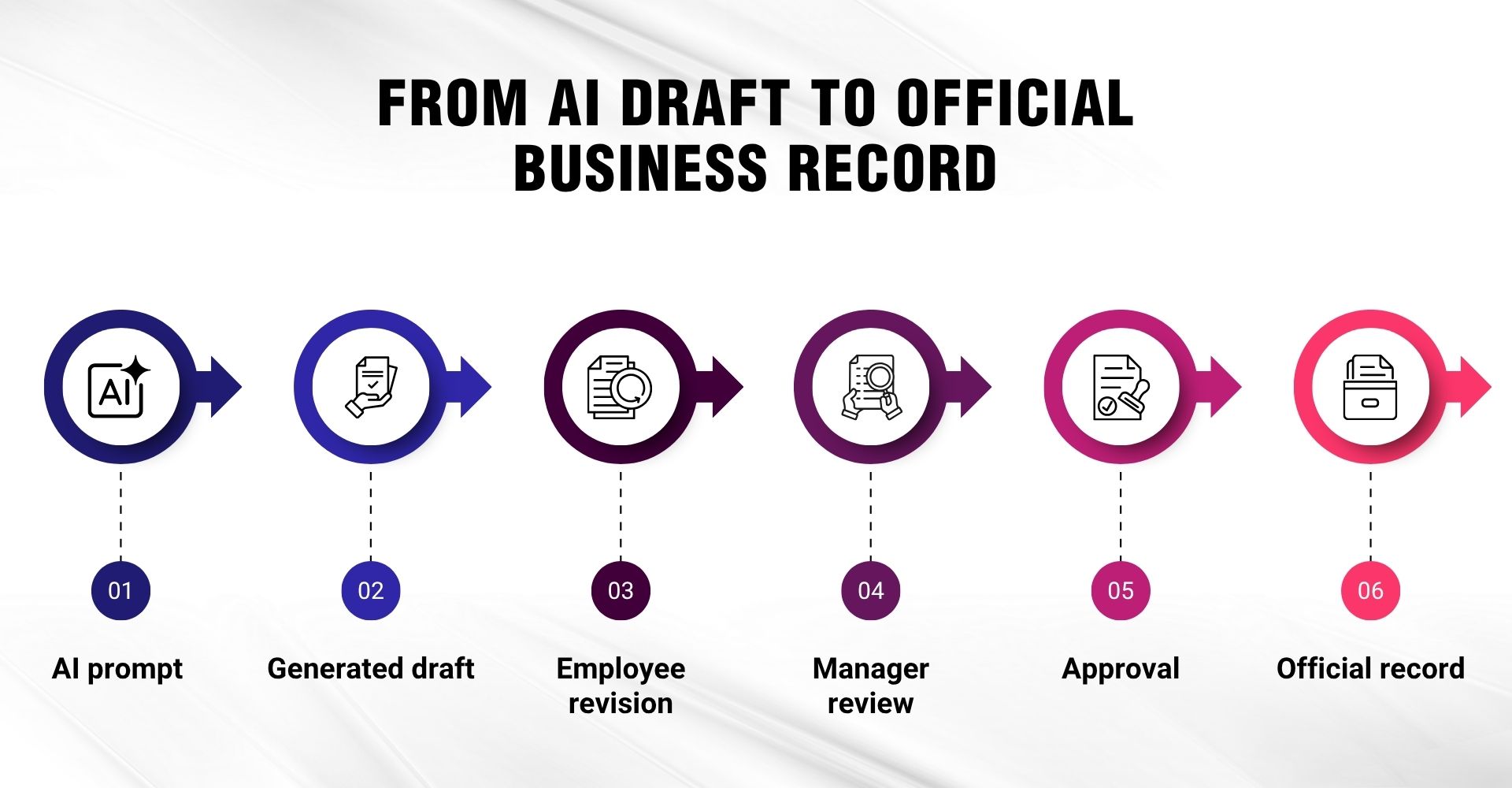
By the end of the process, several versions may exist.
The organization needs to know:
- Which copy is still a draft?
- Which version was reviewed?
- What changed?
- Who approved the final version?
- Where is the authoritative record stored?
This is why document version control becomes especially important when AI makes it easy to create and revise content quickly.
For example, an AI-assisted HR policy may begin as a generated draft. HR revises it, legal reviews it, and management approves a final version. Months later, employees should not have to guess which copy represents the policy the company actually adopted.
Docupile Version Control can help maintain document history, while Workflow Automation can support structured review and approval processes instead of relying on email chains and manually renamed files.
How Should AI Audit Trails and Activity History Be Managed?
AI systems can generate significant activity history, including prompts, responses, timestamps, user activity, and conversation history.
But the existence of that information does not mean every entry needs permanent retention.
An AI audit trail may become more important when it supports:
- an investigation
- an approval
- a dispute
- a compliance review
- an important business decision
NARA’s guidance also discusses audit trails as AI-related materials whose records significance can depend on how they are used.
For businesses, the goal should be traceability where it matters, rather than unlimited retention of every AI interaction.
Once an AI-assisted document enters a controlled records environment, document audit trails can help show who viewed, edited, approved, or shared the record and when those actions occurred.
Retention and Disposal of AI-Generated Business Records
AI records retention should generally follow the purpose and classification of the underlying business record.
For example:
- An AI-assisted employee document may belong to an HR retention category.
- An AI-assisted contract may follow the organization’s contract-retention rules.
- An AI-generated financial analysis may follow the requirements applied to financial or operational records.
Temporary brainstorming material may have little reason for long-term retention unless another business or legal requirement applies.
Businesses should avoid both extremes: deleting important AI-assisted records too early and keeping every prompt, response, and abandoned draft indefinitely.
Retention decisions should consider applicable legal, regulatory, contractual, litigation, and internal policy requirements.
Once those requirements are defined, Docupile can help businesses apply them through retention controls and Legal Hold, supporting the lifecycle of AI-assisted business records that need to remain available.
Sensitive Information in AI Workflows
AI records management also needs to consider what information employees are entering into AI tools.
That can include:
- customer records
- employee information
- confidential contracts
- financial information
- intellectual property
- regulated data
Businesses therefore need clear rules around approved AI tools and permitted information.
Once an AI-assisted document becomes an official record, the organization still needs to control who can access, edit, approve, or share it.
The important distinction is that a document management system does not automatically control activity occurring inside an external AI platform. Its role begins when the resulting business record enters the organization’s controlled document environment.
What Should an AI Records Management Policy Include?
A practical AI records management policy should answer several core questions.
- Approved tools: Which AI platforms may employees use for business purposes?
- Permitted information: What documents or data can be entered into those tools?
- Record trigger: At what point does AI-generated material become a managed business record?
- Authoritative version: How is the official approved copy identified?
- Human review: Who is responsible for validating AI-assisted content?
- Traceability: What versions, approvals, or activity history should remain?
- Retention and disposal: Which retention rules apply, and when can temporary material be removed?
- Access: Who can view, edit, approve, or share the final record?
The purpose is not to create a completely separate records system for AI. It is to connect AI document governance to the organization’s existing records-management practices.
How Can Businesses Manage AI-Generated Records in One System?
Once AI-generated material becomes an official record, businesses need a controlled place to manage it throughout its lifecycle.
A document management system can help bring AI-assisted business records into one structured environment.
| AI records requirement | Relevant Docupile capability |
|---|---|
| Identify the authoritative document | Centralized repository and metadata |
| Distinguish drafts and versions | Version Control |
| Manage review and approval | Workflow Automation |
| Restrict document access | Role-Based Access and Security Class |
| Trace document activity | Audit Trail |
| Retrieve records later | Smart Search, OCR, and metadata indexing |
| Manage the record lifecycle | Retention controls and Legal Hold |
Docupile can also support AI-assisted file naming, metadata extraction, folder suggestions, document type identification, and document summaries.
The organization still decides what should be treated as an official business record. Docupile helps provide the structure and controls for managing that record once the decision is made.
AI Records Management Still Comes Down to One Trusted Record
AI records management is ultimately about knowing which information the business relies on and managing that information consistently.
AI may change how a document begins, but organizations still need to know which version is authoritative, who approved it, who can access it, how long it should remain, and whether it can be retrieved when needed.
As AI-generated documents become part of everyday business work, the objective should not be to keep everything. It should be to identify what matters and manage it as a trusted business record.
Bring AI-Assisted Business Records Under Control
See how Docupile can help your organization move important AI-assisted documents into a structured, searchable, and controlled records environment.