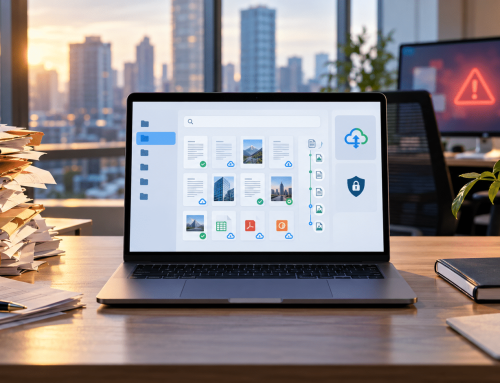

Cloud storage vs document management system is an important comparison for small businesses struggling to organize, find, share, and control growing numbers of documents.
Tools such as Google Drive, Dropbox, and OneDrive work well for basic file storage and sharing. However, as document volumes increase, employees may face duplicate copies, confusing folders, inconsistent file names, missed approvals, and difficulty finding the correct version.
A cloud-based document management solution such as Docupile goes beyond basic storage by helping businesses organize documents, improve search, control access, track versions, and automate routine document workflows.
This guide explains the difference between cloud storage and a document management system and helps you decide which option best suits your business.
Your files may be in the cloud—but are they truly organized and under control?
Why Document Management Matters for Small Businesses

As a small business grows, managing documents through basic folders can become difficult. Employees may spend more time searching for files, checking versions, following up on approvals, and manually organizing new documents.
A document management system helps small businesses:
- Find documents quickly using names, metadata, dates, or document content
- Keep files organized with consistent naming and filing
- Reduce duplicate and outdated document versions
- Route documents through review and approval workflows
- Control access to employee, customer, and financial records
- Track document changes, sharing, and approvals
- Make scanned files searchable with OCR
- Reduce repetitive manual filing work
A DMS is especially useful when documents are increasing and basic folders no longer provide enough organization, visibility, or control.
What Are Cloud Storage and Document Management Systems?
Cloud storage allows small businesses to save, access, and share files online. It works well for basic storage and collaboration but often depends on folders, manual file names, and consistent employee filing habits.
A document management system, or DMS, helps businesses store documents while also controlling how those documents are named, organized, searched, shared, approved, and tracked.
A DMS includes:
- Advanced document search
- Metadata-based organization
- OCR for scanned documents
- Version control
- Role-based access
- Approval workflows
- Audit trails
- Automated naming and filing
- Retention controls
A cloud document management system such as Docupile provides these capabilities online, allowing employees to access documents remotely while maintaining more structured control.
Small businesses that need a wider understanding of these systems can also explore our document management system for small business guide.
Cloud Storage vs Document Management System
Cloud storage is suitable for basic file storage and sharing. A DMS provides more control when documents, users, approvals, and business processes begin to grow.
| Feature | Cloud Storage | Document Management System |
|---|---|---|
| Store and share files | Yes | Yes |
| Organize documents | Mainly with folders | Folders, metadata, and rules |
| Find documents | Basic search | Advanced content search |
| Manage file versions | Basic | More structured |
| Approvals | Usually through email or other tools | Built into workflows |
| Control access | General sharing permissions | Detailed role-based access |
| Track document activity | Limited or platform-dependent | Detailed audit history |
| Automatic naming and filing | Limited | Available |
Better document management is not about storing more files. It is about finding the right file faster.
Benefits of a DMS for Small Businesses
A document management system helps small businesses spend less time managing files manually and gives employees better control over important documents.
These benefits make a DMS useful for growing small businesses that need more than basic file storage and sharing.
How a DMS Supports Everyday Small-Business Work
A document becomes more useful when your team can find it, trust it, and act on it quickly.
How Docupile Goes Beyond Basic Cloud Storage
Docupile is a cloud-based document management and workflow solution that helps businesses organize and manage documents more efficiently.
Relevant capabilities include:
- AI Auto File Naming
- AI-powered document organization
- OCR and searchable content
- Metadata extraction
- Role-based access
- Version history
- Audit trails
- Workflow automation
- Secure cloud access
For example, instead of employees manually renaming and moving each incoming document, Docupile can help apply consistent names and organize files into the appropriate location.
This can reduce repetitive document work while making business information easier to find and control.
Need Better Control Over Your Business Documents?
See how Docupile can help organize, search, control, and automate your document workflow.
Conclusion
Cloud storage is useful for basic file storage, sharing, collaboration, and remote access. It may be the right choice for very small teams with simple document requirements.
A document management system like Docupile is better suited to businesses that need stronger search, organization, version control, permissions, approvals, automation, and audit visibility.
The right choice depends on your document volume, business processes, risks, and growth plans.