

You’ve invested in a Dealer Management System to track inventory, process deals, manage F&I paperwork, schedule service, and support accounting. So when someone mentions a Document Management System, the obvious question is: “Don’t we already have that?” The answer is no. Understanding Document Management System vs Dealer Management System matters because each system solves a different part of your dealership’s workflow.
These are fundamentally different tools, each solving distinct problems in your dealership’s workflow. Having one doesn’t eliminate your need for the other.
Understanding this distinction directly impacts how efficiently your team works, how audit-ready your records remain, and how much time your staff actually spends serving customers instead of searching for files.
The Confusion That’s Costing You Time
Document Management System vs Dealer Management System: Why the Difference Matters
Both systems touch documents, but at completely different points in your operation. Your DMS creates and logs transaction data. It doesn’t specialize in organizing, retrieving, controlling, or tracking documents once they scatter across shared drives, email inboxes, personal folders, and external systems.
A Document Management System takes all the documents your dealership creates and brings structure, control, and automation to their lifecycle. Industry research shows dealerships waste an average of 8-12 hours per week searching for documents across disconnected systems—time that directly impacts F&I throughput, compliance readiness, and staff productivity.
The Real Cost of This Confusion
When dealership leaders assume their DMS handles document management, operational gaps emerge silently. Deal jackets scatter across shared drives with inconsistent folder structures. Vendor agreements live buried in email inboxes. Compliance documents fragment across multiple locations. F&I managers recreate documents instead of finding them. Controllers can’t quickly pull audit trails.
The dealership functions operationally but stays documentally chaotic—a hidden drain on productivity and audit preparedness that compounds monthly.
Document Management System vs Dealer Management System: What Each System Actually Does
A Dealer Management System Runs Your Business
Your DMS is the operational backbone. It manages inventory, processes sales transactions, handles F&I products and contracts, schedules service, and feeds data into accounting. It excels at moving transactions through your dealership’s workflows.
- What it doesn’t specialize in: organizing unstructured files, finding documents across storage locations, automating document flow between departments, tracking granular access history, managing retention policies, or ensuring audit compliance.
A Document Management System Organizes What Your Business Creates
A Document Management System focuses on the documents themselves—their organization, retrieval, control, and governance. It automatically organizes files using AI-powered naming, makes documents instantly searchable through OCR and metadata indexing, controls access permissions, tracks versions with complete audit trails, automates approval workflows, and manages retention schedules.
- It answers questions your DMS wasn’t designed for: Where is that vendor contract? Who accessed this document? When was this last reviewed? Are we compliant with retention policies?
Why One Doesn’t Automatically Replace the Other
Your DMS captures transactions but not supporting context, history, and evidence trails. The goal is both systems working together: your DMS running operations while your document system organizes what those operations produce.
| Feature | Dealer Management System | Document Management System |
|---|---|---|
| Core Purpose | Runs transactions and operations | Organizes and controls documents |
| Inventory & Deals | ✓ Manages | — |
| F&I Processing | ✓ Processes | — |
| AI-Powered Organization | — | ✓ Auto filing & naming |
| Searchability | Limited | ✓ OCR & metadata indexing |
| Access Control | Basic | ✓ Role-based, granular |
| Audit Trails | Transaction only | ✓ Complete document history |
| Workflow Automation | Transaction workflows | ✓ Document routing & approvals |
| Compliance Tracking | No | ✓ Retention & audit-ready |
The Daily Reality Most Dealerships Accept as Normal
Scattered Folders, Scattered Time
Deal jackets exist in your DMS, but backup documentation lives in miscellaneous email folders. Vendor agreements are stored by date created, not by vendor or expiration. F&I staff maintain personal desktop folders because finding shared drive files takes longer than recreating them. When a compliance audit arrives, accounting spends three days pulling documents from five different locations.
According to the American Automotive Dealers Association, 73% of dealerships report difficulty locating specific documents during compliance reviews, often requiring 40+ hours of manual retrieval.
The Second-Order Effect: Hidden Operational Friction
When documents scatter, friction spreads across departments. F&I efficiency drops because staff hunt for documents instead of handling customers. Compliance becomes reactive instead of proactive. Renewal deadlines slip because vendor contract tracking requires manual calendar checks.
The Hidden Costs of Document Chaos
Time Cost: Staff Searching Instead of Serving
An F&I manager handling 40-60 transactions monthly spends 10-15 minutes per transaction locating supporting documents. That’s 7-15 hours monthly—roughly 250-540 hours annually across a three-person F&I department—spent on file retrieval alone. For small dealerships with limited staff, this represents significant opportunity cost that directly reduces customer touchtime and deal velocity.
Compliance Risk: Records You Can’t Quickly Prove or Find
Financial compliance requires demonstrating adherence to F&I disclosure requirements, warranty documentation, and retention schedules. When documents scatter, audit prep becomes multi-week scrambles. You can’t quickly prove retention compliance or access history. Regulatory bodies require organized, retrievable, auditable records.
Error Cost: Manual Work and Duplicate Effort
When finding a document takes longer than creating one, staff recreate instead of retrieve. This introduces versioning errors, inconsistent information across copies, and increased risk of using outdated forms—compliance liabilities that compound over time.
How a Document Management System Fits Into Your Existing Setup
A Document Management System operates as a complementary layer, not a replacement. It organizes outputs from your DMS and daily operations without disrupting existing workflows. It connects to email, accounting systems, and F&I platforms, reducing manual steps that slow staff productivity.
Your DMS is the engine. A document management system is the transmission—it ensures everything your engine produces gets organized, controlled, and routed efficiently. Small dealerships gain disproportionate value: recovering 10-15 hours monthly per person is equivalent to hiring a part-time document coordinator without the ongoing cost.
Benefits of Document Management Systems for Small Auto Dealerships
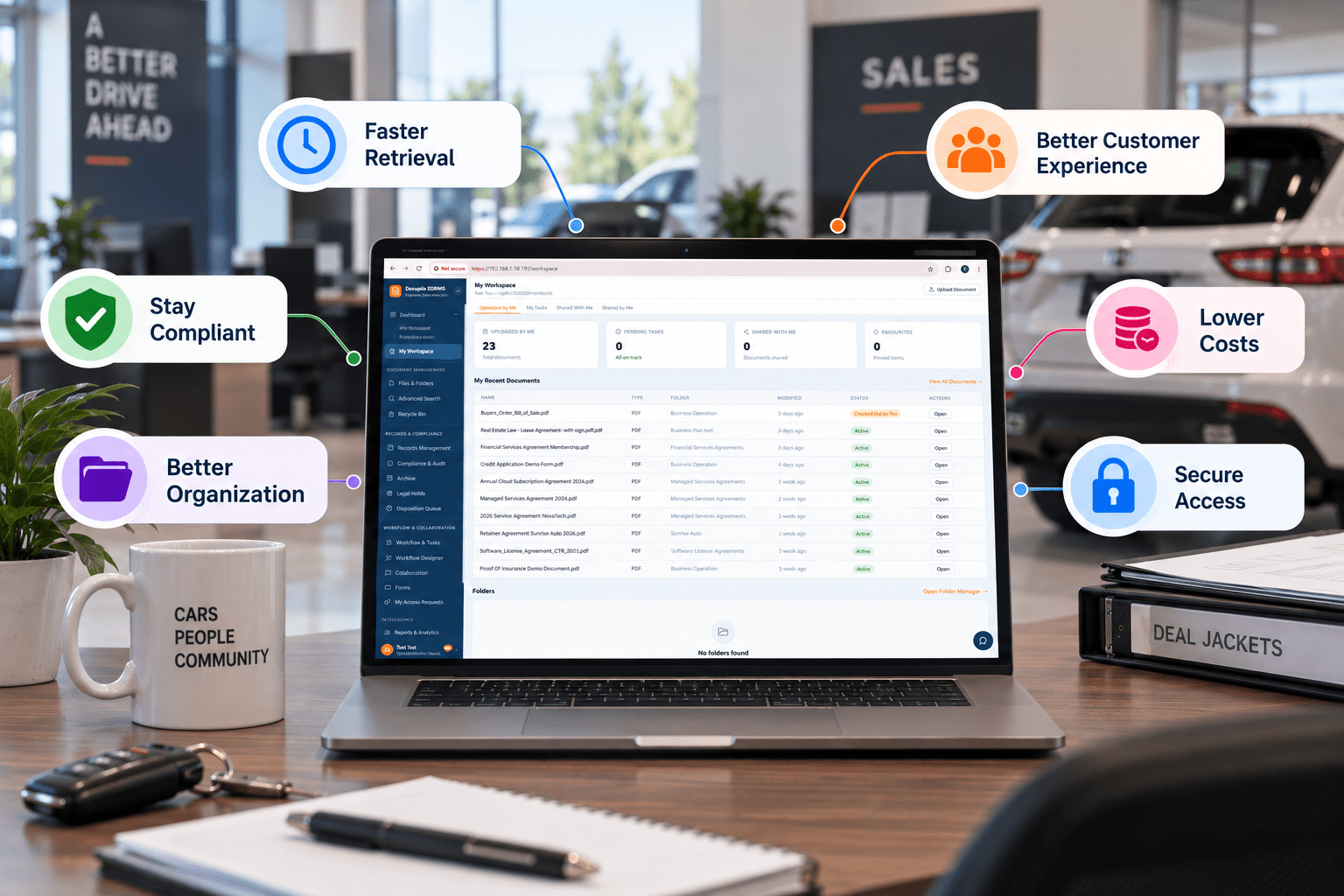
Small dealerships operate with lean teams where each person wears multiple hats. Document management systems deliver outsized impact in resource-constrained environments.
- Instant Productivity Recovery.: Without hiring additional staff, dealerships recover 250-540 hours annually through faster document retrieval. For dealerships with 3-5 F&I and administrative staff, this represents meaningful capacity without payroll expansion.
- Compliance Without Complexity.: Small dealerships lack dedicated compliance officers. Automated audit trails, retention tracking, and deal jacket completeness verification provide the documentation framework large dealerships build into custom processes.
- Customer Experience Advantage.: When F&I staff spend less time hunting documents, they spend more time engaging customers. Faster deal processing and transaction accuracy directly improve CSI scores and referral rates—competitive advantages small dealerships leverage against larger competitors.
- Cost Efficiency.: Cloud-based document management scales affordably. A small dealership implements a system for $300-500 monthly—less than the recovered staff time delivers in monthly value, often within the first month of implementation.
Bringing Structure to Your Document Chaos: Docupile
- AI-Powered Organization Replaces Manual Filing.: Auto file naming and smart folder organization eliminate inconsistent naming conventions. Intelligent search with OCR and metadata indexing replaces manual folder hunting, allowing staff to find documents in seconds instead of minutes.
- Control and Compliance Without Extra Effort.: Role-based access, complete audit trails, and version history secure sensitive records. Deal jacket completeness tracking and vendor contract renewal management reduce oversight risk—critical for dealerships managing dozens of concurrent transactions.
- Workflow Automation Keeps Documents Moving.: The Outlook Add-In captures emails and attachments directly. Automation bridges F&I, accounting, and compliance workflows, ensuring documents reach the right people at the right time without manual intervention.
Implementing a Document Management System for Auto Dealerships
Successful implementation begins with workflow mapping. Identify where documents currently live and which departments create or require access to each document type. Most dealerships complete this assessment in 1-2 weeks.
Next, establish a standardized folder structure aligned with your dealership’s existing processes—deal types, F&I products, service categories, and compliance requirements. Cloud-based systems like Docupile auto-generate this structure, reducing manual setup work.
Training is minimal. Most dealership staff require under one hour to adopt document management systems, particularly when they integrate into existing email and DMS interfaces. The Outlook Add-In requires no behavior change—staff work naturally within their inbox.
Finally, implement gradually. Begin with high-volume document types (deal jackets, F&I contracts) before expanding to service records and vendor agreements. This phased approach builds confidence and demonstrates ROI early, securing buy-in from your entire team.
From Scattered Files to Controlled, Findable Records
What Changes for Your Team
F&I staff stop recreating documents and start retrieving them instantly. Accounting gains complete audit trails for every record. Managers access deal jacket status in real-time. Compliance preparation shifts from crisis mode to routine verification.
What Changes for Your Bottom Line
Recovered staff time translates to increased customer engagement and transaction throughput. Compliance exposure drops. Audit preparation compresses from weeks to days. Dealerships using Docupile report 35-45% reduction in document retrieval time and 90%+ compliance audit readiness without additional administrative overhead.
Ready to Stop Searching and Start Controlling Your Dealership Documents?
Document chaos costs you time, compliance risk, and operational visibility every single day. Docupile transforms scattered documents into a controlled, auditable asset—without disrupting your current systems or requiring extensive operational changes.