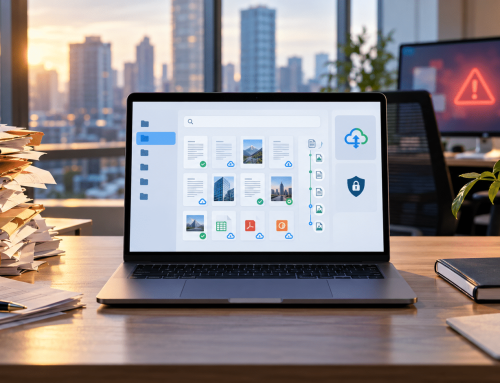

Around 5,000 Dropbox accounts were recently compromised through a legacy Lenovo ID integration, according to reporting by The Register and BleepingComputer. The reported access path did not require attackers to know the affected users’ Dropbox passwords. Instead, the issue was tied to Lenovo’s email-verification process and an older authentication connection between Lenovo ID and Dropbox.
Dropbox said attackers accessed files belonging to fewer than one-third of the affected users. The company also confirmed that none of the affected accounts had two-factor authentication enabled. The unauthorized access reportedly occurred between August 4 and August 21, 2026.
For businesses, the most important question is not whether Dropbox itself is safe.
It is this:
How many identities, applications, integrations, and users can still reach your cloud files today?
It is also the kind of access visibility that platforms such as Docupile are designed to support.
What Happened in the Dropbox/Lenovo Incident?
BleepingComputer reported on September 2 that Dropbox had notified affected users about unauthorized account access linked to a problem in Lenovo’s email-verification process.
According to the notification described in the report, the issue allowed an unauthorized party to create a Lenovo ID using a Dropbox user’s email address. That Lenovo identity could then be used to access the Dropbox account associated with the same email address without requiring the Dropbox password.
Lenovo described the issue as involving a legacy integration between Lenovo ID and Dropbox. Dropbox responded by expiring sessions authenticated through Lenovo IDs and introducing an additional requirement for a Dropbox password when Lenovo ID authentication is used. Lenovo said its customers were not affected and that its investigation was continuing.
The incident does not show that cloud storage itself is unsafe.
What it does highlight is how an older identity connection can remain relevant to file access long after users stop actively thinking about it.
That raises five questions worth asking inside any business that relies on cloud-based documents.
1. Who Can Still Access Your Files?
Most businesses know who is supposed to have access.
That is not necessarily the same as knowing who has access right now.
Access tends to accumulate quietly over time. Employees move into new roles without always losing permissions from their previous ones. Contractors are added for temporary projects. Teams create shared folders for convenience. Group permissions expand as new people join, while older access is rarely reviewed with the same urgency.
The result is that someone may still be able to reach documents simply because access was granted months or years earlier and never revisited.
A regular cloud file access review should identify active users, administrators, contractors, external collaborators, privileged accounts, and group-level permissions.
The key question is simple:
Does everyone who can reach a sensitive business document still have a legitimate reason to do so?
2. Do You Know Every Third-Party Login That Can Still Reach Your Files?
This is the most important business lesson from the Dropbox/Lenovo incident.
Businesses increasingly connect cloud repositories to identity providers, single sign-on services, automation platforms, scanning applications, backup tools, collaboration systems, and other third-party services.
Each connection can create another route to company information.
What makes this particular incident notable is that some affected users reportedly did not even have Lenovo accounts. Dropbox said Lenovo Identity Provider Services formed part of its authentication infrastructure, which meant the old connection still mattered to account access.
That creates a practical governance problem.
An integration may have been created years ago. The person who configured it may have left. The workflow may have changed. Employees may never interact with that service directly anymore.
Yet the connection may still exist.
Businesses should therefore ask:
Which third-party identities and applications are connected to our file environment? Who approved them? What permissions do they have? And are they still necessary?
From an access-governance perspective, forgotten does not mean disconnected.
3. Is MFA Available, or Is It Actually Enforced?
Dropbox confirmed that none of the affected accounts had two-factor authentication enabled.
That does not mean MFA should be treated as a complete explanation for the incident. But it does reinforce an important business distinction:
offering MFA is not the same as requiring it.
Dropbox allows team administrators to require all or some team members to use two-factor authentication through the admin console or an identity-management provider.
Businesses should review whether stronger authentication is consistently applied to standard users, administrators, privileged accounts, external access, and connected identity systems.
4. What Can Someone Do After They Get Access?
Authentication answers one question:
Can this person get in?
Permissions answer another:
What can they do once they are inside?
A user may be able to view a document, download it, edit it, delete it, create external links, or change who else can access it.
Those permissions should reflect the person’s actual role.
Someone who only needs to review an invoice should not automatically have the same level of control as the administrator managing the entire repository.
That is why an access review should examine not just who has access, but how much access they have.
5. If Someone Reached a Sensitive File Today, Could You Reconstruct What Happened?
Imagine management discovers that a confidential contract or customer record was accessed unexpectedly.
Could the business quickly answer:
- Who accessed it?
- When?
- Was it downloaded?
- Was it shared?
- Was anything changed?
- Which version existed before the activity?
If answering those questions requires searching emails, contacting several employees, or piecing together information from different systems, the problem is no longer only access.
It is visibility.
Dropbox, for example, provides security alerts on eligible team plans that can show administrators who was responsible for an event, what occurred, when it happened, and which files or people were affected.
The broader lesson for cloud file access is that organizations need enough activity history to understand what happened after an important file is accessed or changed.
Where Docupile Fits?
Document management is only one layer of business security. It does not replace identity security, endpoint protection, network controls, authentication systems, or a broader cybersecurity program.
Its role is to help organizations maintain stronger governance over the documents themselves.
Docupile supports that through capabilities such as role-based access, audit trails, version history, controlled sharing, and centralized document management.
Those controls help businesses answer practical questions such as:
Who can access this document? What changed? Which version is current? And what happened to it over time?
The objective is not simply to move files into another cloud platform.
It is to maintain better visibility and control over the records the business depends on.
Take a Closer Look at Who Can Access Your Files
The Dropbox/Lenovo incident is a useful reminder that cloud file access can extend beyond the accounts employees think about every day.
Review active users, former employees, external shares, third-party integrations, privileged accounts, MFA settings, and file-access visibility to identify permissions or connections that may no longer have a legitimate business purpose.
If your business needs better visibility and control over document access, sharing, version history, and activity, see how Docupile can help.
Later this month, we will look at another side of document risk: what happens when ransomware does not only affect working files, but threatens the recovery path too.
Editor’s Note: This article reflects publicly reported information available as of September 2026. Details may change as Dropbox, Lenovo, or other parties release additional findings.
Sources
BleepingComputer, September 2, 2026 — reporting on the Lenovo email-verification flaw, the legacy integration, the access period, and Dropbox’s remediation.
Dropbox Help Center — supporting information on requiring two-factor authentication and security-alert visibility for eligible team plans.