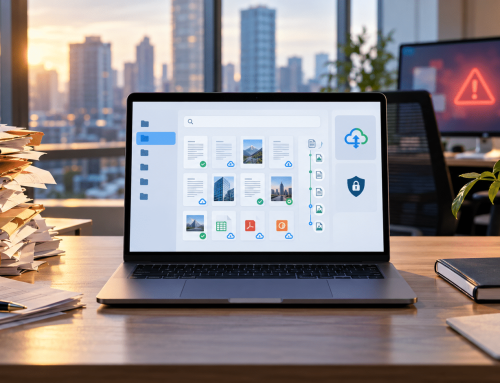

OneDrive vs DMS matters when storing files is easy, but managing them is not.
Many auto dealerships already use Microsoft 365 for email, spreadsheets, meetings, and day-to-day file sharing. OneDrive often becomes the natural place for employees to save customer paperwork, finance documents, reports, scanned records, and other working files.
That can work well when the dealership mainly needs cloud access and collaboration. The challenge begins when employees must do more than store files. Managers may need to confirm whether a deal jacket is complete, identify missing paperwork, find a scanned document quickly, control access, or track who is responsible for the next step.
This is the central question in the OneDrive vs document management system comparison: Is OneDrive enough for the dealership’s document process, or is a dedicated DMS needed?
OneDrive vs DMS: What Is the Main Difference?
OneDrive is primarily a cloud file-storage, synchronization, and sharing tool. It helps employees access files across devices, collaborate on Microsoft documents, and share records with colleagues.
whereas, a document management system focuses on what happens around those files. It can help classify documents, connect them to the correct transaction, track their status, control access, support workflows, and make records easier to retrieve.
| Capability | OneDrive-based process | Document management system |
|---|---|---|
| Cloud file storage | Core capability | Core capability |
| File organization | Folders and naming rules | Folders, metadata, document types, and automated classification |
| Deal jacket completeness | Usually checked manually or through a separate tracker | Can support document checklists and status visibility |
| Missing paperwork | Identified through manual review | Can show missing or pending records |
| Search | File names, content, filters, and Microsoft search tools | OCR, metadata, document type, and structured search |
| Access | Sharing and permission settings | Role-based and process-specific access |
| Workflow | Requires configuration or connected tools | Can be built around document activities |
| Renewal tracking | Usually managed separately | Can support alerts based on document dates |
| Activity tracking | File activity and administrative reporting | Document-focused activity and audit history |
How One Deal Moves Through a Dealership?
Consider a single vehicle sale.
The salesperson receives the customer’s identification and insurance documents. The F&I team later adds the buyer’s order, financing forms, signed disclosures, and optional product agreements. Office staff then add title, registration, trade-in, and delivery records.
OneDrive can store and share all these files. But the folder itself may not answer the questions a dealership manager needs to ask:
- Are all required deal documents present?
- Which document is still missing?
- Has the latest version been saved?
- Is the file stored under the correct transaction?
- Who needs to complete the next step?
Someone may still need to open the folder, compare every file against a checklist, and contact the right employee.
That is where OneDrive document management may begin to depend heavily on manual review.
Dealerships that need clearer document-status visibility can use [deal jacket completeness tracking] to see which records have been received and which are still missing.
Take the 60-Second Dealership Document Test
Answer these questions based on your current process:
If you answered “yes” to most of these questions, OneDrive process may already meet the dealership’s needs.
Several “no” answers may indicate that the problem is no longer file storage. The dealership may need a more structured document process.
Several “No” Answers?
See how Docupile helps independent dealerships add document tracking, deal jacket visibility, and structured workflows alongside Microsoft 365.
When Is OneDrive Enough for an Auto Dealership?
OneDrive may be enough when:
- The dealership has a small and manageable document volume
- Employees follow consistent naming and folder rules
- Managers are comfortable checking records manually
- File sharing is the main requirement
- Important deadlines are tracked reliably elsewhere
- The dealership does not need centralized document-status reporting
It remains useful for spreadsheets, presentations, reports, internal files, and everyday collaboration.
The key is whether the existing process remains reliable as more employees, deals, and documents are added.

When Should a Dealership Consider a DMS?
A dealership may need a DMS when:
- Missing paperwork is regularly discovered late.
- Managers spend too much time reviewing folders manually.
- Employees use inconsistent file names or storage locations.
- Scanned records are difficult to find.
- Document access is hard to manage consistently.
- Renewal dates and follow-ups are tracked across separate tools.
- Staff cannot quickly see the current status of a transaction.
A DMS can reduce the manual effort required to manage these processes. It can give the dealership a more consistent way to organize records, monitor document status, assign access, and keep work moving.
The right OneDrive vs document management system choice therefore depends on the dealership’s process, document volume, and need for visibility, not simply its preference for one technology over another.
What Changes When a DMS Is Added?
With a folder-based process, employees often need to remember where documents belong and what must happen next.
A structured DMS can shift that responsibility from individual memory to a defined process.
Documents can be classified when they are added. Naming can be standardized. Scanned records can be found through OCR and metadata. Deal jacket status can be reviewed without opening every file. Renewal dates can trigger reminders. Activity history can make responsibilities easier to understand.
The goal is not to add another system without a reason. It is to reduce the manual work that remains around dealership documents.
OneDrive Does Not Have to Disappear
The decision is not always OneDrive or DMS.
A dealership can continue using OneDrive and Microsoft 365 for communication, spreadsheets, shared working files, and everyday collaboration. A document management system can be used for records that require more structure, status visibility, access control, or workflow management.
This may include:
Each platform can serve a different purpose.
How Docupile Fits Into the Process?
Docupile provides a structured document-management layer for independent auto dealerships that need more control than a file-based process can provide.
It can help teams organize dealership records, track deal jacket completeness, search scanned documents using OCR and metadata, manage access by role, review document activity, automate workflows, and monitor vendor-contract dates.
Docupile works alongside the dealership’s Microsoft 365, dealer management, CRM, accounting, sales, and other business systems rather than replacing them.
Explore how [automotive document management software] can support deal jackets, document retrieval, access control, and dealership workflows.
Dealerships can also use [vendor contract renewal tracking] to review important agreements before renewal or expiration dates arrive.
OneDrive vs DMS: Which Is Better for Your Dealership?
OneDrive vs DMS is not always an either-or decision.
OneDrive is a practical choice when the dealership mainly needs accessible cloud storage, file synchronization, and straightforward sharing.
A DMS becomes more valuable when the dealership needs documents to follow a structured process. This includes confirming completeness, tracking missing paperwork, controlling access, finding scanned records, and monitoring deadlines.
For many dealerships, the best approach may be to use both.
The final OneDrive vs dms decision should be based on how much structure the dealership needs around its records. OneDrive can support everyday collaboration, while a purpose-built DMS manages documents that require clearer status, stronger organization, and more consistent accountability.
Need a More Structured Dealership Document Process?
See how Docupile helps independent dealerships organize records, monitor missing paperwork, control access, and manage document workflows alongside Microsoft 365.