Shared drives make storing and sharing business documents convenient. Teams create folders, upload files, and collaborate without complicated processes.
But what happens when a manager needs an approved contract, an employee leaves with knowledge of critical folders, or nobody knows who owns an important record?
The documents exist. Finding and managing the right ones becomes the problem.
This is where the shared drive vs document management system decision becomes important.
A shared drive answers: Where do our files go?
A records strategy answers: Can we find, trust, control, trace, and recover the right record?
Storage isn’t control. As businesses grow, that difference becomes harder to ignore.
What Are the Signs Your Shared Drive Is No Longer Enough?
A shared drive rarely becomes ineffective overnight. Warning signs develop through everyday operations.
Five signs worth examining:
- Searching takes too long. Employees navigate nested folders, guess filenames, or ask coworkers where documents were saved.
- Nobody owns the official record. Three departments use the same contract, but nobody maintains its approved copy.
- Filing rules differ across teams. Finance organizes records by year, HR uses employee names, and Operations relies on project folders.
- Permissions remain unchanged. Employees switch roles or leave projects, but old access rights remain.
- Approvals happen outside the system. Employees email documents, wait for responses, and manually move approved files into folders.
These problems indicate that document management depends on processes the business hasn’t standardized.
A Real-World Example: Heritage Financial
In a March 20, 2026 SEC filing, Heritage Financial Corporation disclosed a cybersecurity incident detected on or about March 2 involving an internal file-share server used by employees.
Files were exfiltrated and may contain personal information. The company stated that the bank’s customer accounts, customer systems, and operations were not impacted.
The filing doesn’t establish that a DMS would have prevented the incident. It reinforces a broader question: Does your business know which important records exist in shared environments and how they are governed?
Shared Drive vs Document Management System: What’s the Difference?
Both solutions store and share files. The distinction lies in how documents are organized, governed, and managed across business processes.
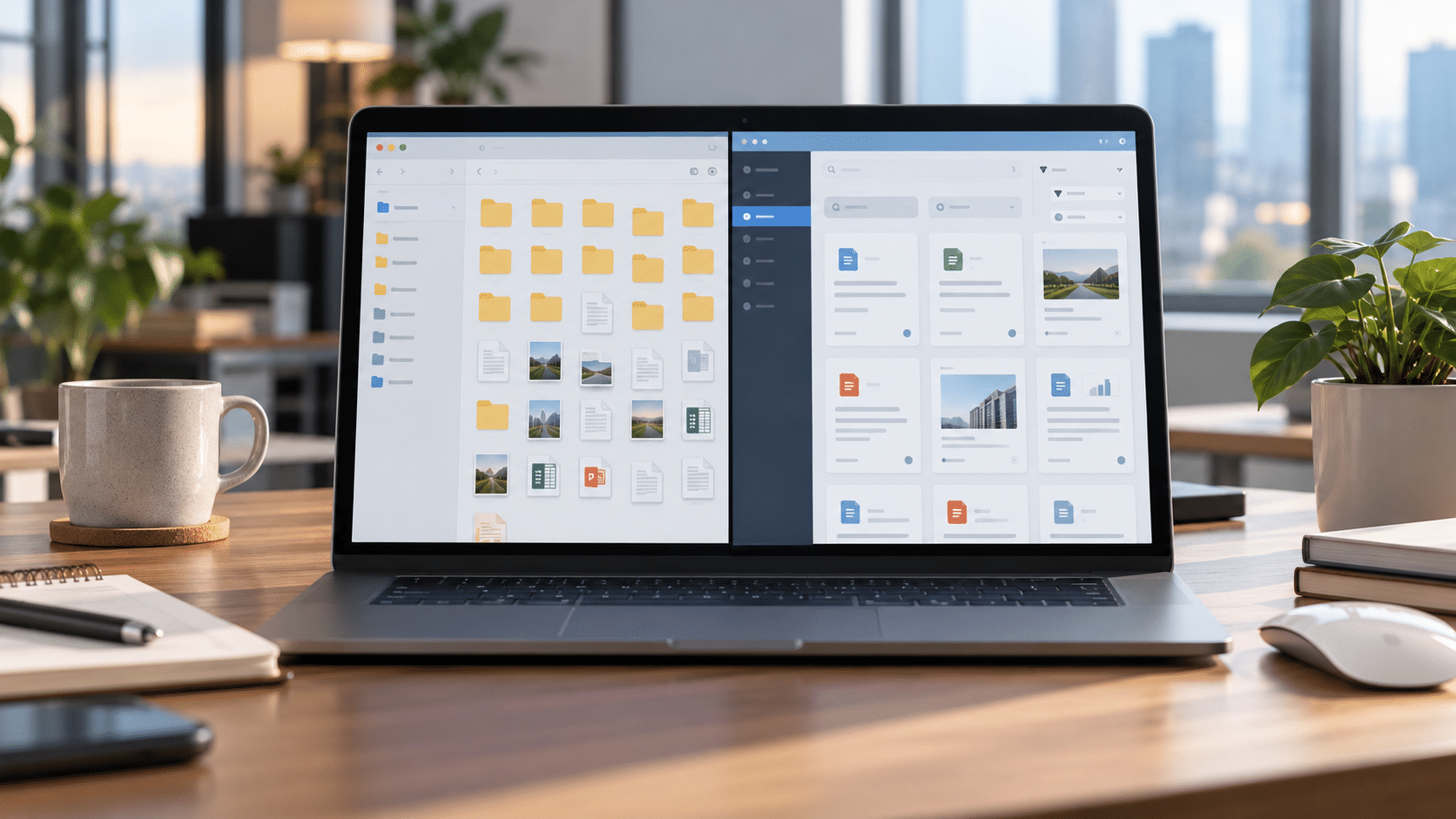
Modern shared platforms provide capabilities such as content search, permissions, and version history. A dedicated DMS brings document-focused capabilities into a structured environment.
| Business requirement | Shared drive | Document management system |
|---|---|---|
| Organization | Shared folders and file structures | Folder, metadata, and document-type classification |
| Search | Filename and available content search | OCR, full-text, and metadata search |
| Ownership | Team or folder responsibility | Defined record ownership and classification |
| Permissions | User, group, and sharing controls | Role-based and document-level permissions |
| Approvals | Manual or connected workflows | Integrated document approval workflows |
| Auditability | Available file activity and administrative logs | Document-focused audit trails |
| Lifecycle | Policies or separate tools | Retention, archiving, and disposition controls |
Capabilities depend on the product, licensing, and configuration.
The difference isn’t simply more features. It’s how consistently organizations manage records without disconnected tools and manual processes.
Docupile brings together OCR and metadata search, role-based permissions, version control, audit trails, and document workflows within one document management environment.
These capabilities help teams retrieve and manage records through business-specific information rather than relying entirely on folder locations.
For businesses evaluating a shared drive alternative, these operational differences deserve more attention than storage capacity alone.
What Should a Records Strategy Actually Answer?
A records strategy establishes accountability throughout a document’s business lifecycle.
Five questions provide a practical framework.
Find — Can employees locate the right record?
Documents should be searchable by relevant information such as customer names, contract numbers, document types, or content, rather than filenames alone.
Trust — Which copy is official?
Employees must distinguish approved records from working drafts. Version history and documented approvals help identify the correct version.
Control — Who should have access?
Permissions should reflect job responsibilities and change when those responsibilities change.
Learn more about how to review cloud document access, including old accounts, integrations, and external sharing.
Trace — What happened to the document?
Audit records help establish who accessed, modified, or approved important documents, supporting accountability and internal reviews.
Recover — Can the business retrieve the right record after disruption?
A backup that restores the wrong version, or one nobody can access, isn’t effective recovery. Identify critical records and test whether the correct versions can actually be restored.
Read more about protecting backups and recovering business documents.
Together, these five questions establish a practical foundation for document disaster readiness.
Who Can Still Access Your Business Files?
Before choosing a new system, carry out a quick access review. Check who owns each critical record category, which groups have access, whether former employees retain permissions, and which external shares remain active.
Use these findings to identify the records that need more structured control.
How Can You Move From a Shared Drive to a DMS Without Carrying the Mess Over?
Switching systems won’t automatically correct years of inconsistent filing and document ownership.
The best approach is to clean up the process before migrating the records.
Step 1: Prioritize Critical Records
Start with frequently used, sensitive, and business-critical documents.
Active contracts, financial records, and employee files are practical starting points. General reference materials can follow later.
Step 2: Review Existing Documents
Identify duplicates, outdated folder structures, and inconsistent naming conventions.
Flag records requiring retention review rather than deleting them automatically. Disposal decisions must follow applicable legal, contractual, and business requirements.
Step 3: Define Ownership and Metadata
Assign responsibility for each document category and decide which information employees need for retrieval.
For example, contracts could be classified by customer, contract number, document type, and effective date.
Docupile’s metadata and search capabilities support structured document retrieval based on this information.
Step 4: Recheck Access Permissions
Review user groups, departmental responsibilities, and external access before migration.
Document-level permissions allow businesses to define access around individual records rather than relying entirely on broad folder permissions.
Step 5: Pilot One Business Workflow
Select a department or document category and test the new process before expanding.
Confirm that employees can:
- Find documents without knowing filenames.
- Identify the responsible record owner.
- Access records appropriate to their roles.
- Follow the required approval process.
- Retrieve the correct documents without searching multiple locations.
A successful migration isn’t measured only by how many files were transferred. It’s measured by whether those files become easier to manage and use correctly.
Give Your Business Documents More Structure and Control
Docupile helps businesses organize documents, improve retrieval, manage permissions, and support structured document workflows.
See how these capabilities could fit your existing processes.